Thursday, 15 October 2015

Stillwell Hills/Ledinghams Depot Traverse.

Get comfortable, maybe even grab a cuppa. This is a very lengthy but worthwhile read (in my opinion anyway).

On our way. A brief stop for lunch at Jelbart Glacier. (Photo credit: Angus Cummings).

The most distant outpost encompassed by our station is Ledinghams Depot. Situated in the Stillwell Hills area it is approximately 150 kilometres west of Mawson Station, and is visited most years only to carry out maintenance. In saying that, there were no visits from 2010 to 2014. The depot was named after Rod Ledingham, who was a very successful and greatly respected geologist and field training officer with the Division many years ago, and has life long connections with Antarctica, having first worked as a meteorologist with the British in 1966.
The view over Ledinghams Depot (Photo credit: Angus Cummings)


This year I had the incredibly good fortune to be selected as one of the six from our ANARE (pronounced "a-nah-ree", Australian National Antarctic Research Expedition) to participate in a five day sea ice traverse to carry out a hut inspection and undertake some gas fitting work. In all honesty I really wasn't looking forward to the trip. 150kms across the ice is a long way, and when I refer to ice, it is in fact sea ice, but is largely covered with compacted sastrugi (snow which has blown into wave like bumps by the high winds we get here), which makes for a very uncomfortable slow journey. However, despite my reluctance I knew the positives would outweigh the negatives (with the right attitude I think they always do).

So it was that after two to three months of planning, field safety training refreshers, and meticulous organisation we set off in two Hagglunds early on Monday morning, September 21. We had waited all month for the weather to line up five to six perfect days, and when a good week finally arrived we were ready to go.

The first leg of the journey was to end at Colbeck Hut, in the Colbeck Archipelago. This is approximately 90kms from Mawson, and to get there we travelled around a number of glacier tongues. Some of these glaciers are huge and left me in awe of their majesty. Each one is different to the next. Some are incredibly wide and don't protrude out from the coast as far as you'd expect, whereas some are breathtakingly rugged, broken, and finish in the most spectacular formations advancing miles out to sea. The colours in parts of the walls would have to be the most beautiful deep blues that nature can produce. They are truly spectacular.
A section of the very rugged and broken Taylor Glacier.


Along the way we encountered a number of seals lazing around tide cracks close to the coast or a glacier, often accompanied by emperor penguins. Proof again for me that emperors enjoy the company of other creatures. Often around glacier tongues we crossed a number of large tide cracks, which had to be assessed before we drove over them. Tide cracks are sometimes undermined and therefore the ice on the edges can be unstable and may collapse when driven on. Hagglunds have been claimed before by these as a result of lack of caution. At a cost of several hundred thousand dollars for a Hagg, the Division goes to great lengths to educate us in the correct precautions to take. Also important to remember is that Haggs are now only built for military use, so in effect are irreplaceable.

Tide Crack!!
A berg broken off the end of Jelbart Glacier, tide crack in the foreground.
 

Finally after six or so hours we arrived at Colbeck Hut and set about preparing our home for the night. Colbeck is sited on an island, which is locked in sea ice most of the year. It is yet another beautifully peaceful location. As I've mentioned before one of the most enjoyable things I find when in these remote locations is the absolute quiet. Here you only need to walk for five minutes and you can be completely alone and away from other peoples noise. I could literally sit forever and just enjoy the silence. It is something I will miss incredibly when I leave. As well as the peace, the surrounding islands and ice add to the picture. It's impossible for me to describe how these things combine to make me feel. I can only say it promotes absolute calm within. Something I don't experience very often.

Looking back toward Colbeck Hut and the RMIT van.
After a good nights sleep we set off early on Tuesday bound for Stillwell Hills. A detour to Tilley Nunatak (an Inuit word for an isolated peak of rock protruding from ice or snow) had been scheduled to check the condition of a small fuel cache. When we arrived we had to battle a very isolated katabatic wind of about forty to fifty knots around the Nunatak. So isolated that only a few hundred meters either side the wind was minimal. It's probably hard to comprehend if you haven't experienced it but Antarctica is like that. Many times we have been on station and had virtually no wind, yet a kilometer or so either side you can see snow blowing off the plateau at what looks like one hell of a rate of knots.
Tilley Nunatak (Photo credit: Angus Cummings).
Despite the wind Tilley was a very picturesque place, and I was disappointed we were unable to spend enough time there to have a good look around. The fuel cache turned out to be two jerry cans of ATK (aviation turbine kerosene?), and I was left unsure of the point in having such a small amount of fuel as an emergency supply when the distance to safety is so great. I guess someone thought it was a good idea.

After fifty kilometres or so we entered the Stillwell Hills area, which was yet another breath taking vista. Maybe the reason the area seems so beautiful is because so much of what we see around station is just ice plateau. I'm not completely sure, but approaching the area you are suddenly surrounded by distant islands, ice bergs, and exposed rocky hills and headlands. Again, words don't do it justice and I'll never be able to describe how much the scene pleased my eyes.

Looking toward Stillwell Hills from William Scoresby Bay.
Ten kilometres later we arrived at the depot and were pleasantly surprised by the hut. It was my understanding that the hut was small and that we would be spending our nights in a polar pyramid (a pyramid shaped tent designed to withstand a blizzard). I was wrong. The hut is an extended "Apple" (a round fibreglass structure which deconstructs into separate panels, making it easy to ship to the continent, and consequently transport to site and erect). This type of shelter was pioneered by Ledingham himself, so it is fitting that the largest form of it we have is erected at the site named after him. In this case the "Apple" is in fact a "Zuchini", as it has four straight sided panels fitted to the middle to extend it. It was large enough for five of us to sleep in, three on narrow bed settee type arrangements, and two others on squabs on the floor. Our trip leader J.B. (who I've mentioned in previous blogs) slept outside in his bivvy, as he always does.

"The Zuchini" (Photo credit: Pete Layt).

We had arrived early enough in the afternoon to get a head start on the work that we had to do, and in no time I had installed a new gas regulator, tested the pipework and completed a general inspection of the installation. Little Pete, our electrician found that what he had been told needed doing in fact didn't, so had given me a hand. Big Pete, our chippie started removing old silicone from the joints between the panels with a little help from J.B. and Angus (normally our station Met Tech, but in this case one of our two tourists on the trip, the other being Paul who is one of our diesos who had come in case we had mechanical troubles, but ended up driving for a bit.). Soon enough it was knock off time and a few of us wandered off to briefly explore the nearby surrounds. Others sat in the hut.


Fjord type inlet just over the hill from Ledinghams Depot.

Day two (Wednesday) at Ledinghams dawned true to forecast. Calm, sunny and warm (-14 degrees), what more could you ask for in such a wonderful place. Our plan for the day had been decided the evening before, so we all chipped in to assist Big Pete with the remaining task of stripping out the old silicone from the panel joints so he could finish earlier and we could all spend the best part of the day exploring the region in the Haggs in search of the Fold Island emperor colony.


We spent a number of hours driving around the islands, stopping to take photo's of various bergs and ice formations until we finally located the penguins. We had decided earlier that if we found the penguins we would not approach too closely due to the fact that this colony is undisturbed by humans normally unlike our regular haunt of Auster. Ironically we ended up right in the path of the birds that were transiting to and from the colony, and they seemed as curious as their cousins at Auster so I'm not sure that our caution was called for.
The distant Fold Island emperor colony.
However it did demonstrate our policy of leaving the Antarctic as undisturbed as we possibly can, which I believe is a very important philosophy to live by. Along the way we came across the most intense and colourful collection of small jade "growlers". These are rarely seen very small bergs, formed from incredibly clear green water that resemble large chunks of pounamu. They are spectacular to look at from a distance, and even better when you are standing right next to them. Many photo's were taken and a couple were climbed (they were relatively small).
Small jade berg "wave".


We returned to the hut late in the afternoon in time to spend some more time wandering around the local area climbing various hills to take in the expansive views. It always amazes me how far you can see from a high point here. Because of the lack of air pollution you can literally see for miles so bergs that may be fifty miles out to sea are clearly visible through a zoom lens or binoculars.


Before long it was time to return to the hut to prepare dinner and settle in for the night, in preparation for the return leg to Colbeck. Our chef back on station had prepared a whole lot of meals for our trip and vacuum packed them so basically all I had to do each night was thaw them in hot water and heat them in a pot. The most I did was boil the rice, pasta, or mix instant "real" mashed potatoes (which is surprisingly good). Awesome work Kim, it was greatly appreciated.

The crew inside the Ledinghams Zuchini (Photo credit: Pete Layt)


After an early start the next day we headed away from Ledinghams bound for Colbeck. It was a quiet journey for the first hour or so. I'm not sure if it was because the other two were taking in the scenery again or not, but personally I was a bit sombre knowing that in all reality, I will never have the opportunity to see this beautiful part of Antarctica again. Maybe if I was given the opportunity to come back to Mawson for a winter again it would happen, but having had the privilege of visiting Stillwell Hills I think I would probably encourage my counterpart on station to take the opportunity if they hadn't had the chance before. It would be selfish doing otherwise. On reflection I know I have achieved a  number of "firsts and lasts" this year and I have been incredibly fortunate.

The highlight of the journey from Ledingham to Colbeck was a mid-day stop at Proclamation Point. This is the spot that in 1931 Sir Douglas Mawson staked his claim to the part of Antarctica that is now recognised as Australian Territory. He was the leader of a joint British, Australian and New Zealand (BANZARE) expedition at the time so the visit had real significance not just to my Aussie mates, but myself as well. Once we'd had time to reflect on the differences between the way we explore the region compared to Dougie, and also had a bite to eat we continued on with our journey.

The original claim erected by Douglas Mawson
 in 1931. It was lost and then rediscovered in the
1950's by expeditioners visiting the site.

Next stop was beside Taylor Glacier, close to Taylor Rookery. Four of the party walked the three kilometres to get within one kilometre of the rookery. I declined as I couldn't really understand the attraction considering I can have them walk right up to me at Auster. Instead I hung around the Hagg and was entertained by passing emperors who often stopped to spend some time observing me before they continued on their trek to a distant tide crack or the open sea.

We finally arrived at Colbeck Hut for the second time and set about making our home for the night. Being very tired from the days travel it was an early night for all of us, knowing we had another ninety odd kilometres to go until we reached Mawson again.

Again the next day we had an early start. The plan was to arrive back on station early enough to unpack the Haggs and redistribute all our gear to the correct locations, fuel up and park away the Haggs in time for a pre dinner beer and brag session with our mates that had remained on station for the week. Along the way we detoured to visit and photograph a very big jade berg that was discovered earlier in the winter. This was an absolute sight to see. The colour of these things is really beautiful, and as I said before it was such a pleasure to be able to get right up next to it. It is a sight I will remember for a long time.


Majestic jade berg.
Another strange occurrence during the Colbeck-Mawson leg happened around midday. Looking toward the north you could see what appeared to be expansive ice cliffs which were in fact a mirage. I had seen mirages here before but not to the extent of this one. If you didn't know better you'd have thought you were surrounded by distant cliffs. Photo's were taken and to my surprise showed the vista clearly.
The ice cliffs that appear real but don't exist.

We finally arrived back at Mawson around 2.30pm in a lot quicker time than the outward trip. The sled we were towing behind our Hagg for the first leg to Colbeck had compressed the snow on the way out, so following our tracks from five days earlier made the travelling a lot smoother, and therefore quicker. A stop on the sea ice just before we entered Horseshoe Harbour to shake hands and thank each other for a successful and safe trip was a nice touch instigated by our trip leader J.B.


Before we knew it all our gear was unpacked and I was enjoying my first hot shower for five days. Then it was off to the bar to catch up on the weeks news and tell everyone about our week.
This trip will probably be remembered as the highlight of my year. The penguins at Auster would have to be a close second, but the fact that even fewer people have had the opportunity to visit the Stillwell Hills area made it so much more special to me and a memory I will remember for a long, long time. I have to say I am incredibly grateful for having been given the chance to be a part of the trip.
The Ledinghams Traverse Party. We knocked the bastard off!
Thanks go to my fellow traverse crew, J.B. (John Burgess, FTO and Trip leader), Big Pete (Pete Layt, chippie, BSS, and therefore my immediate boss on station, not that you'd know it by the freedom he gives us), Little Pete (Peter Lecompte, sparky, and my room mate in Hobart), Angus Cummings (Met Tech, trip trades assistant and the youngest on station), and Paul Amos (dieso, and in effect a Ledingham tourist as he didn't do a lot other than drive). It was an absolute pleasure to be a part of the trip with you all.

Sunday, 11 October 2015

Auster Rookery, emperor penguins, and seal pups.

Early evening light on an iceberg near Macey Island, Antarctica.

It seems impossible to believe that my first visit to view the emperor penguins at Auster Rookery was over four months ago. That was the very beginning of June, and I had been in Antarctica for just over three months. Now with less than four and half months left I wonder where the time has gone, and I know my remaining days here will be over before I know it.
The pristine atmosphere allows for incredible light.

Our summer crew of eleven new expeditioners arrive in roughly one months time. It will be strange to see new faces. Having lived in such isolation for so long, I quite often wonder how the dynamics of our little community will be effected by the newcomers. We will discover soon enough, but I'm sure it will add even more fun to station life.

However, the fact that the sea ice will close for travel sometime around the end of November has spurred the station into action and has seen a number of trips recently undertaken, so as to spend as much time at Auster as possible. As I have said before, we may not get the opportunity to come this way again, and every trip could be your last.
This penguin CAN fly.... An Emperor exiting a hole in the sea ice.

I have visited five times now. More than some of us on station, but less than others. I hope to see them at least twice more. I have witnessed the varying stages of growth. From eggs carried on the fathers feet, to newly hatched chicks clinging to life by desperately hiding from the bitterly cold environment under their parents body, standing on the tops of their feet.
Little balls of fluff.
Now, the chicks are about half way to moulting (which occurs about January), and are little balls of fluff that tear around the place in search of their parents when they are feeling hungry, which seems like always. Gradually they are growing towards independence.

My last trip out we took advantage of the longer daylight and left at 2pm on Saturday afternoon for Macey Hut. Leaving in the afternoon gave us more time at the rookery on our first day, and allowed for a relaxing start on Sunday. This time three of us travelled on quad bikes, with another two travelling in a Hagg. A side benefit of this is that we were able to dump most of our gear in the Hagg and travel light on the quads. Quad travel on the sea ice is awesome, especially the glassy smooth blue ice. I couldn't stop myself from playing like a newly licensed teenager in his mothers car....... I call it reliving my youth. Some of my old mates that read this will remember what I'm talking about. Naturally it's all to do with safety, learning how to control a quad bike in a slide..... Yeah, I don't buy it either.
Tucker time.

So anyway, having been so many times now the novelty of the penguins has worn off a bit, and we have all started exploring the surrounding areas, finding tide cracks where the birds and seals enter and exit the water, and getting a little closer to bergs than we probably should do...... It's safe at the moment, with the cold things are still very frozen so not that likely to break up. It has given me many opportunities to photograph things other than penguins and their chicks. Recently we managed to get some great shots of penguins cavorting in a swimming hole which has been created from a tide crack.

Emperor Soup.
Another variation on the earlier visits now is the side trips to Islands along the route to view the Weddel seal pups. We saw the first two on the return leg of the last trip, so in future trips we expect to see a lot more. You can imagine how cute these little new-borns are. Their doe eyes draw smiles from everyone.

No matter how good a trip was, it is still always good to get home to station. Describing what you have seen to those that stayed behind while you were out playing I find cements the experience in my mind a bit more firmly. There's also the thrill of reviewing and sharing photo's with the others who accompanied you on the trip. Lastly the opportunity to share the experience though photo's on Facebook is always something I look forward to. Sharing the things I have seen with friends and hearing delight from them is one of the rewards of technology I really enjoy.

Barely a day old.

See what I mean about the eyes? (Photo Credit: Kate Kloza)
 

On that note I shall finish. I have just written my name up on the board for another trip this weekend. We leave Friday afternoon. Who's keen to come with me?

Climb Every Mountain...

Well, not every mountain, and in this case not actually a mountain. Just a tall island.

It was a beautiful day here today. Warm (-8.8 degrees, so warm compared to -30 degrees), sunny, and calm. Having been watching the forecast for a few days I decided to ride out to Welch Island with my mate Robbie, as we were both keen to get a few photo's from the top.

Welch Island from the sea ice.

So, after lunch quad bikes were loaded with our survival packs and also a tray bag containing a "quad recovery kit" (for self rescue from a tide-crack or when bogged in snow) and a "quad bivvy" (a tent type shelter you can erect between two quads in the event of rapid deterioration of weather).

We set off just before 1pm, and fanged across the sea ice towards Welch. A stop around the corner from station was suggested to photograph a berg that has a hole through the end of it that resembles a giant bullet hole. Soon after this we arrived at Welch, logged a radio call with VLV Mawson to report that we were off the sea ice, and then began the climb. Welch is only about three kilometres from station so it doesn't take long to get there.
The giant bullet hole.
From the other side it is almost perfectly round.

The climb is normally easy, unless like us you don't know the easy way. Instead Robbie and I zig-zagged up the steepest side, finally realising the easy way would have been to walk up an obvious spur (obvious when we crossed onto it about fifty meters from the summit!). Never mind, it was a good climb and meant I could change my plans of going to the gym when we returned to station.

The view from the top, looking toward station,
Casey Range in the background.
The views from the top were worth the effort of getting there. It is another place that I was able to enjoy the serenity, not a sound could be heard, other than the odd crack now and then from moving sea ice. The complete silence is one of the things I get great enjoyment from here. After half an hour or so at the top it was time to come down. It was an easier downwards path we took so we were soon back at the quad bikes and off across the ice to check out some seals. No pups in this group, so onwards we travelled, via a couple of patches of blue ice which gave us the opportunity to practice "skid control" on slippery ice (that the politically correct term for "we did some doughies").

After only two hours we were back on station and unpacking the quads. Such a small effort for such an awesome Sunday afternoon. Knowing how easy it is now I will do more of these sorts of quick trips in an effort to make the most of the time we have left here.

Zoomed photo of Mawson Station from a mile or so out on the sea ice.

Sunday, 2 August 2015

The Emperors 2.0

It's been quite a while since I have written anything here. The reason for that is that there really hasn't been anything to write about. June and July are the months that provide us with the most darkness, which means the opportunity and the motivation to travel off station are minimal. I did in fact venture up on the plateau for a work trip to each of our three field huts with some others one day early in July. We chose a crystal clear day which meant the views were spectacular. The downside of the clarity was the temperature. Not taking into consideration any wind chill, the air temperature was around -40 degrees Celsius. So cold you could feel the surface of your tongue freezing as you breathed.

Now however the daylight hours are extending, which means more opportunity and enthusiasm for "jollies" out on the sea ice to visit the penguin rookery. It is still bloody cold (July and August are our coldest months) but on a calm day the low temperatures don't have the bite that you'd expect once you've acclimatised. The realisation that we are now virtually half way through our time here also boosts motivation to make the most of every day that presents itself as suitable for such opportunities. And so it was that last Sunday myself and six others departed Mawson at 8am bound for Auster Rookery. Four of us planned to stay overnight, with the other three returning to station that evening.

We arrived at Auster at 11.45am, after a very bumpy journey across approximately sixty kilometres of sea ice and snow drift.
Peak hour traffic, Antarctic style.
The Hagglunds we travel in are great machines, but generally are built for purpose, not creature comfort. Nearly four hours bouncing around in the back with virtually no suspension takes a toll on your body, especially with a lower back that likes to remind me of my age at the slightest opportunity.

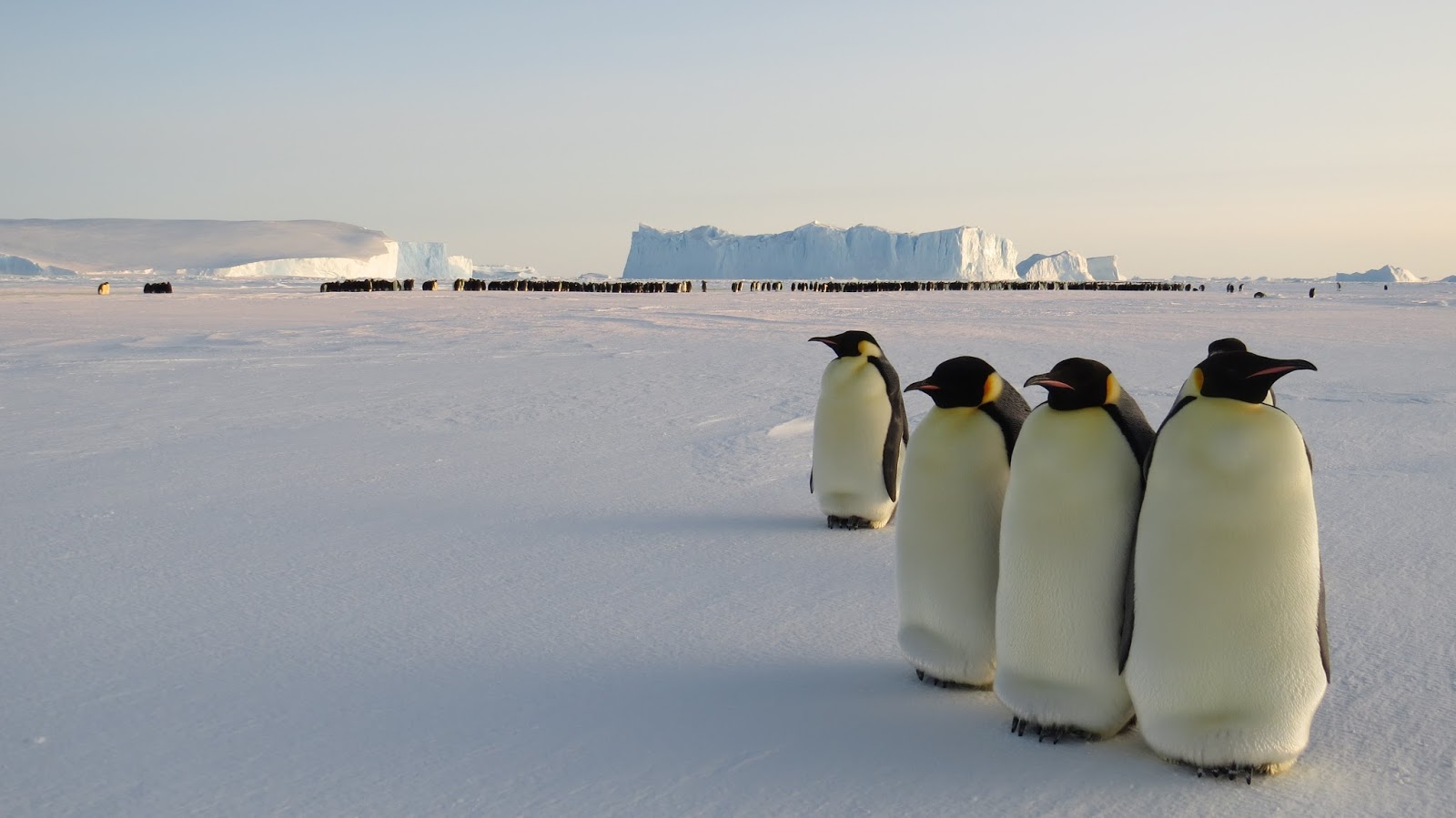
Sunday was overcast but calm, which meant a comfortable day at the rookery. The light wasn't great for photo's but the penguins didn't care. Within minutes of arriving, and less than halfway from the Hagg to the rookery I found myself surrounded by a welcoming committee that had broken away from the massive congregation to come and greet us. This group had started walking towards the Haggs as soon as we arrived. When I stopped halfway across they deviated and made a beeline for me. Proof to me that they actually enjoy our company. This provided an early opportunity to fulfil a request I'd received from home. My neighbour back home is studying different ways to chill water as a school project, and Deb had suggested I should get some photo's of a glass of water in the snow or ice with some penguins in the background.
As soon as they noticed me they hurried over.

The penguins and the glass of water....
With the photo's taken, as well as a short video, I spent the next hour or so just enjoying the tranquillity of the location and the company of my new feathered friends.

Soon enough our time at the rookery was over for the day, and we departed for Macey Island and the hut that would be our home for the night. The other three travellers continued on toward Mawson while we unloaded our gear and proceeded to get the hut warmed up for the night. Each hut contains a small gas heater and a three burner cooker and oven. Along with this it has solar electricity as well as 230 volt circuitry which enables us to connect to a generator and plug in an electric fan heater. With all of these heat sources going it only takes an hour or two to bring the inside temperature up to a comfortable level. Soon enough the four of us were settled in with a hot cuppa and cheese and crackers, as we relived the days events.

Monday dawned an absolute cracker of a day. The sunrise was spectacular, and soon we were packed up and on our way back to the rookery.
The dawning of a perfect day.

The light that is presented here makes it almost impossible to take a poor photo.
The light was perfect for photography, and the penguins were just as keen to hang out with us as they always seem to be. Soon I was again surrounded by a group of nine, and we spent over an hour together before I had to move due to the fact I was starting to seize up. When I stood up and walked away all of my new friends followed me for several minutes, then some broke off and headed back into the larger group. Five of them however continued to follow, and eventually gathered around me again when I stopped about three hundred meters away on the other side of the rookery. They really are the coolest creatures. They walk up to you and just stand and look. Sometimes they'll circle you, but mostly they are just content to stand in front of you and hang out. The only conclusion I can draw is that they genuinely enjoy human interaction.

Again, the time to begin the journey home arrived all too soon, and we sadly said farewell to our friends once more. Each time I leave I am only too aware that I may never get the chance to come back. All it would take is for me to injure myself badly on station and my field travel would be severely limited. It is for this reason that we all take every opportunity we are given to get back out there again. Hence the reason I am planning another overnight trip this Thursday. The weather is looking good.

I know I've written it here before, but visiting the penguins at Auster really is a special thing There are many reasons why. The fact that I am amongst only a few people in the world who will ever have the opportunity to visit and interact with these special creatures in such a beautiful location is only a small part of it.
And they'll stand with you for hours. How could you not love them.

The rookery in the background. The angle doesn't show, but it would be over a kilometre long.
There are many things that make the experience so wonderful. The birds themselves are amongst the most beautiful you could wish to look at. Their plumage is just immaculate, and they are so open to us, curious and eager to approach us. They are also possibly the most gentle creatures I have ever encountered. I have not yet seen one emperor display even the slightest aggression to another. They just seem to coexist in absolute harmony. The location they choose to come to breed every year is possibly the most breath taking place I have ever visited. Not just for it's scenery, but for the sheer untouched and unadulterated rawness of it.
The obligatory selfie.
The fact that it is as isolated, and remote as you can get in this world is yet another aspect that adds to the experience.

We have roughly another four months until the sea ice weakens and closes to traffic. Unfortunately that day will come all too soon. Our schedule for the last half of our year here will be busy with various projects starting up as spring and summer develop. I will continue to make the most of every opportunity I am given to visit my new friends the emperors.

Future generations.
The day will sadly come when I will have to say good bye to them for the last time. I have come to enjoy their company immensely, and I will not be surprised if I find a tear in my eye when that moment arrives, knowing that I will most likely not pass this way ever again.


Saturday, 27 June 2015

Antarctic Mid-winter celebrations!

June 21 is officially the shortest day of the year in the southern hemisphere, generally considered mid-winter (ignoring the fact that winter has really just begun). Normally at home the only significance this day presents to me is the fact that the daylight hours now start extending, meaning soon I'll be able to get out fishing and diving after work again, and my spring deer stalking trip is not far away.

Not so in Antarctica. Here it is a time for a great celebration. Traditionally it was the celebration of reaching the halfway mark of an expedition, but to me it was a celebration of all who have been before us, and the friendship shared with my fellow expeditioners here at Mawson. Expeditions these days are scheduled to suit each station and the access made possible by climatic influences. Our's is the last of the three continental Australian stations to be resupplied due to the fact that we have to greatest amount of sea ice that only breaks out at the end of summer to allow ship access, if it breaks out at all. Therefore, we are still a long way from being halfway through our expedition. We have nearly another nine months until we arrive back in Hobart. Our colleagues at our two other continental stations will be home by the end of the year.

So it was then that the week leading up to June 21 saw a flurry of activity in preparation for the biggest day of the Antarctic calendar. As the plumbers it was our job to get the outdoor spa up and running (officially known as the "emergency snow melter", due to the fact that "officially" it doesn't exist). This is a big steel tank that has been cut in half  lengthways, with a package burner bolted on and a circulation pump plumbed in. It sounds easy, but in fact it took us three days to get it running and installed outside the Red Shed. It was worth the effort though judging by the enjoyment it provided to the few that used it. Our efforts seemed minor compared to the mammoth task that our chef Kim had in preparing a nine course meal. Several other members of our crew put a lot of effort in to the preparations as well, some a lot more than others but generally everyone chipped in (but as always it was the usual suspects putting the biggest effort in....). Kate, our Doc, took charge of decorating the dining room for the main function as she always does.
Again Kate transformed the room into something really remarkable. Sunday morning a brunch was planned to be held in one of the historic huts but blizz conditions put paid to this. Instead last minute decorations were made upstairs in the wallow (by the usual suspects, again).

The days programme started with brunch at 10am. This was a vast menu of pastries, brioche, smoked salmon, bacon, eggs, sausages, the list goes on.
Following this we all pitched in and cleaned up the wallow, then the kitchen and a few of us spent a bit of time in the kitchen doing what we could to help out the chef. At 1pm Kate opened the "cocktail bar" and like moths to a flame some of us found ourselves drawn in that direction. It was my week rostered as ERT leader so I had to limit my drinking, which these days doesn't bother me so much as it once would have.

At some stage during the afternoon official group photo's were taken, and eventually 4pm arrived and the main celebratory meal commenced. This seemed to go on forever, with no end to the food. I think we eventually finished eating at about 8pm, after having a break for speeches, and toasts to various countries and important people before dessert. My job was to toast New Zealand, which prompted me to research my own country's Antarctic history.

Once the eating was concluded, and the kitchen and dining room cleaned up, we all headed upstairs for the evening entertainment. This consisted of the traditional mid winter rendition of Cinderella (starring yours truly as Cinders),
plus a number of original performances by individuals. The nights formalities were capped off with the unveiling of our plaque marking the 68th Mawson ANARE. This is something that is produced every year to hang on the wall marking our time and effort here.

As would be expected on such an occasion most of the crew spent a few more hours propping up the bar, which is always a good way to spend a few hours here. A few laughs were had, and a few glasses of liquor were consumed, but by 1am the festivities were complete for another year. Despite my initial lack of enthusiasm in the lead-up to the event I ended up having a really great time. The whole day had a really good feel about it, and we all contributed to making it a success. The next big celebration will be Christmas and New Year, by which time we will have another nine expeditioners who will have joined us for the summer. I eagerly look forward to that, as I'm sure it will be another memorable time, soon after which will be our departure for home.

Sunday, 7 June 2015

Sea ice and the Emperors.

Last Saturday was a sad day in my time here at Mawson. Our normal Saturday involves two hours work in our respective trades between 8am and 10am, then we have a cooked brunch, and after this is our time to perform our "station duties". This particular Saturday I was greeted at smoko by one of my colleagues telling me to ring Deb urgently, and to do it from my room. Straight away I new that Jazz, my black Labrador and best mate of thirteen years had passed away. Something that I had always known was on the cards with me being away for so long, but none the less not easy news to accept. She was a special dog.
 
So, with that still on my mind three days later I was not exactly full of enthusiasm to participate in the field on a trip to Auster penguin rookery that we'd had planned for two weeks. With the thought that it would help take my mind off the loss I decided to go and try and make the most of it. In the end it proved to be a good decision.

I packed my field travel survival gear on Monday afternoon, and after work our party of four loaded up one of the Hagglunds with our gear and food etc ready for an early departure the next morning. Because of the remote possibility of the Hagg ending up in the sea through a tide crack our survival packs have to be lashed to the roof of the Hagg trailer. This is so that in the rare event we should end up "in the drink" we can access our gear without having to climb into the machine. I should point out that they do actually float, and have bilge pumps in them also. However, in the past they have had one or two sink due to the bilge pumps being clogged up. We have recovery kits we carry which are set up to winch them back on to the ice should such an event occur.

Tuesday morning arrived and after a quick meeting over breakfast the four of us piled into to the Hagg at 8.30am, called in our first radio sched as we left station, and then we were off. Our route was out across the sea ice, which at the moment is anywhere between 800 and 900mm thick. You'd expect that this would be a nice smooth trip, but normally we deal with snow drifts and sastrugi that can make it very slow going. Our first hour was good, but after that we were down to about eight kilometres per hour for some time. By 9.30am the sun had slowly risen close enough to the horizon to throw a bit of light on our surroundings, lighting up bergs as well as the ice plateau of the continent. The colours of the entire horizon at this point of the sun are truly amazing.
Our Hagg on the vast desert like sea ice.

Sea ice travel is quite a unique experience. The closest way for me to describe it would be to compare it to driving across a vast endless desert, which is studded now and then with massive rocks of varying shapes, only in this case the rocks are icebergs. Some of the open stretches of ice are just so vast all you see is just a flat continuous ice plain out in front of you that seems endless. Some of the icebergs you pass by are gigantic and majestic. At one stage we stopped in a very open area, with bergs surrounding us but at least twenty miles away. I just had to get out and take it all in. It seemed incredible to me, having spent so much of my life on the ocean, to able to stand ON the ocean in such vastness. At the same time the flat vastness of it just blew my mind.
A distant berg on the sea ice at dawn.

Eventually we had clicked off the 55kms to Macey hut where we would be staying the night. We slowly cruised between the bergs that surround Macey Island, and continued our journey towards Auster rookery. The bergs surrounding this area are numerous, resulting in a very indirect course. If you'd looked at our GPS trail you'd think we'd been drinking. However, after another 10kms had clicked over, we passed between two bergs and there they were, a long lone of huddled emperor penguins. Immediately memories of the documentary "March of the Penguins" came to me. This was the rookery that was filmed as the subject of that documentary. In fact, one of the watercraft operators who was on the ship we sailed to Mawson was one of the film crew. To be standing there, seeing something that so many people have seen on TV and is so well known, but only maybe a thousand have actually seen in person was a very special thing indeed. Once again I gave thought to the good fortune I have had to be selected to come to Mawson Station.
I named her in memory of Jazz.

On our first day we spent about two and a half hours with the emperors. They really are a beautiful bird. Their plumage close up is so detailed and intricate, and their colours just blend so well. They look so graceful, but also awkward as they march the many miles across the ice toward the rookery. How they are able to find their way back there year after year is probably something we will never understand.

I sat for a while on the first day just soaking it all in. The scale and beauty of the surrounding bergs, with the light from the low sun was spectacular, and the penguins with their gentle presence just capped it off. At one stage I stood looking around at the scene and I had to sit down. I refer to it as sensory overload, one of the others
Auster Rookery. The sight that greeted us on arrival.
saw me and called it an "Antarctic moment". It happens down here frequently. None of the emperors came overly close to me on the first day, other than one that passed a meter away from me on its way to the rookery. It was as if I wasn't even there, but I was still thrilled never the less. Long before it seemed like what was actually two and a half hours was up, we headed back to the Hagg and began our drunken trail back to the hut for the night arriving at the hut at about 3.30pm, just as a full moon was rising between the bergs. Yet another spectacle. After unloading our gear, Trev cracked a bottle of port, Kate made a up a cheese platter, and the four of us sat down and began a very pleasant evening which capped off a perfect day.
Full moon at Macey.

The next day, we completed our 10am radio sched after a quick clean up, loaded the Hagg and drove back to the rookery. The sight of the line of penguins on the second day was no less spectacular than on our first arrival. This time however they seemed a lot more interested in spending time with us. Kate had one keep her company at about a meter and a half away for over half an hour, while I had several come within three or four meters and just hang out. The highlight was when Kate stood up and wandered off, "her" penguin just stood and looked around as if to say "hmmm, what now?". That was until it spotted me about seventy meters away and seemed like it thought "oooh, there's another one, but that one's red!! I'll check that one out too!!" Straight away it started walking in my direction. She/he (I prefer to think she...) came up and stood about a meter in front of me and made a few noises, then walked around behind me and stopped for a while to check me out. Then, after a few seconds came back in front and turned her back to me while looking over her shoulder. Then, around the back she went again, and again in front with her back turned. I could only figure that what she was expecting me to do was show her what I looked like from behind. She did this about five or six times over the fifteen minutes we spent together. It was both amusing and
intriguing. Eventually it was time to depart on our four hour journey back to Mawson. I was surprised when I stood up, instead of being alarmed my friend just stood there and looked up at me. I explained that I had to go (I doubt she understood) and started to walk away. After a few paces I looked back to see her following me!! She did this for about ten meters and finally stopped and just looked around, seemingly lost as to what to do next. It made me feel like picking her up and bringing her home.

The journey home was via a different route, closer to the coast, with some interesting bergs on the way. We completed out trip in near darkness arriving with just enough time to unpack and squeeze in a beer while describing our trip to others on station and comparing experiences with the others that had already been.
Lone ranger.

New arrivals.


The sea ice remains open for travel through until mid November, so many more trips will be made to Auster by us all. The rookery is an aspect that is unique to Mawson Station so it is up to us all to make the most of the opportunity. It is a sought after posting, so there is no guarantee we will be given the chance to come here again.
Back turned again....


Late afternoon light on the plateau.
A berg on the journey home.
Berg after sunset.