Sunday, 2 August 2015

The Emperors 2.0

It's been quite a while since I have written anything here. The reason for that is that there really hasn't been anything to write about. June and July are the months that provide us with the most darkness, which means the opportunity and the motivation to travel off station are minimal. I did in fact venture up on the plateau for a work trip to each of our three field huts with some others one day early in July. We chose a crystal clear day which meant the views were spectacular. The downside of the clarity was the temperature. Not taking into consideration any wind chill, the air temperature was around -40 degrees Celsius. So cold you could feel the surface of your tongue freezing as you breathed.

Now however the daylight hours are extending, which means more opportunity and enthusiasm for "jollies" out on the sea ice to visit the penguin rookery. It is still bloody cold (July and August are our coldest months) but on a calm day the low temperatures don't have the bite that you'd expect once you've acclimatised. The realisation that we are now virtually half way through our time here also boosts motivation to make the most of every day that presents itself as suitable for such opportunities. And so it was that last Sunday myself and six others departed Mawson at 8am bound for Auster Rookery. Four of us planned to stay overnight, with the other three returning to station that evening.

We arrived at Auster at 11.45am, after a very bumpy journey across approximately sixty kilometres of sea ice and snow drift.
Peak hour traffic, Antarctic style.
The Hagglunds we travel in are great machines, but generally are built for purpose, not creature comfort. Nearly four hours bouncing around in the back with virtually no suspension takes a toll on your body, especially with a lower back that likes to remind me of my age at the slightest opportunity.

Sunday was overcast but calm, which meant a comfortable day at the rookery. The light wasn't great for photo's but the penguins didn't care. Within minutes of arriving, and less than halfway from the Hagg to the rookery I found myself surrounded by a welcoming committee that had broken away from the massive congregation to come and greet us. This group had started walking towards the Haggs as soon as we arrived. When I stopped halfway across they deviated and made a beeline for me. Proof to me that they actually enjoy our company. This provided an early opportunity to fulfil a request I'd received from home. My neighbour back home is studying different ways to chill water as a school project, and Deb had suggested I should get some photo's of a glass of water in the snow or ice with some penguins in the background.
As soon as they noticed me they hurried over.

The penguins and the glass of water....
With the photo's taken, as well as a short video, I spent the next hour or so just enjoying the tranquillity of the location and the company of my new feathered friends.

Soon enough our time at the rookery was over for the day, and we departed for Macey Island and the hut that would be our home for the night. The other three travellers continued on toward Mawson while we unloaded our gear and proceeded to get the hut warmed up for the night. Each hut contains a small gas heater and a three burner cooker and oven. Along with this it has solar electricity as well as 230 volt circuitry which enables us to connect to a generator and plug in an electric fan heater. With all of these heat sources going it only takes an hour or two to bring the inside temperature up to a comfortable level. Soon enough the four of us were settled in with a hot cuppa and cheese and crackers, as we relived the days events.

Monday dawned an absolute cracker of a day. The sunrise was spectacular, and soon we were packed up and on our way back to the rookery.
The dawning of a perfect day.

The light that is presented here makes it almost impossible to take a poor photo.
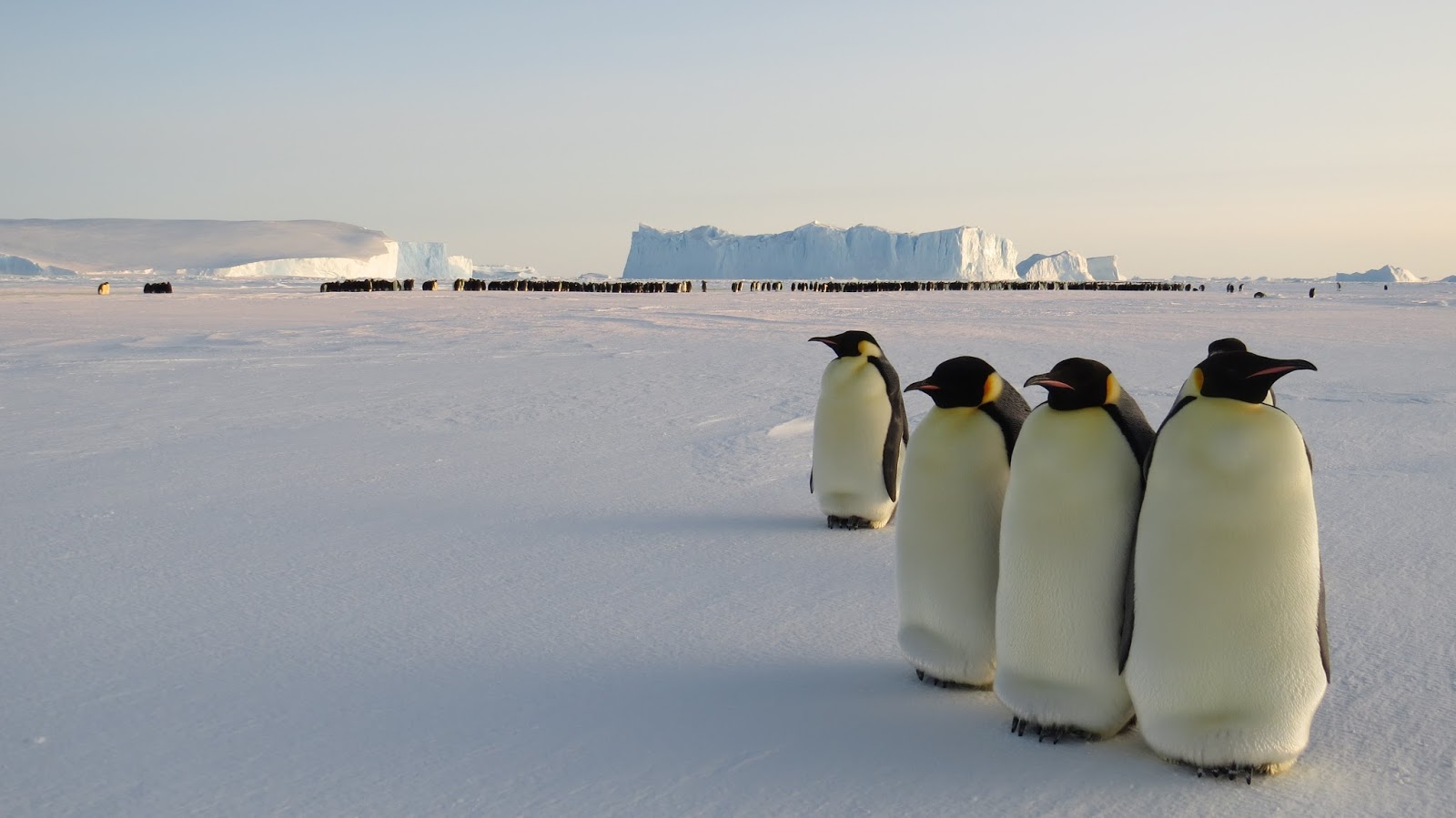
The light was perfect for photography, and the penguins were just as keen to hang out with us as they always seem to be. Soon I was again surrounded by a group of nine, and we spent over an hour together before I had to move due to the fact I was starting to seize up. When I stood up and walked away all of my new friends followed me for several minutes, then some broke off and headed back into the larger group. Five of them however continued to follow, and eventually gathered around me again when I stopped about three hundred meters away on the other side of the rookery. They really are the coolest creatures. They walk up to you and just stand and look. Sometimes they'll circle you, but mostly they are just content to stand in front of you and hang out. The only conclusion I can draw is that they genuinely enjoy human interaction.

Again, the time to begin the journey home arrived all too soon, and we sadly said farewell to our friends once more. Each time I leave I am only too aware that I may never get the chance to come back. All it would take is for me to injure myself badly on station and my field travel would be severely limited. It is for this reason that we all take every opportunity we are given to get back out there again. Hence the reason I am planning another overnight trip this Thursday. The weather is looking good.

I know I've written it here before, but visiting the penguins at Auster really is a special thing There are many reasons why. The fact that I am amongst only a few people in the world who will ever have the opportunity to visit and interact with these special creatures in such a beautiful location is only a small part of it.
And they'll stand with you for hours. How could you not love them.

The rookery in the background. The angle doesn't show, but it would be over a kilometre long.
There are many things that make the experience so wonderful. The birds themselves are amongst the most beautiful you could wish to look at. Their plumage is just immaculate, and they are so open to us, curious and eager to approach us. They are also possibly the most gentle creatures I have ever encountered. I have not yet seen one emperor display even the slightest aggression to another. They just seem to coexist in absolute harmony. The location they choose to come to breed every year is possibly the most breath taking place I have ever visited. Not just for it's scenery, but for the sheer untouched and unadulterated rawness of it.
The obligatory selfie.
The fact that it is as isolated, and remote as you can get in this world is yet another aspect that adds to the experience.

We have roughly another four months until the sea ice weakens and closes to traffic. Unfortunately that day will come all too soon. Our schedule for the last half of our year here will be busy with various projects starting up as spring and summer develop. I will continue to make the most of every opportunity I am given to visit my new friends the emperors.

Future generations.
The day will sadly come when I will have to say good bye to them for the last time. I have come to enjoy their company immensely, and I will not be surprised if I find a tear in my eye when that moment arrives, knowing that I will most likely not pass this way ever again.


Saturday, 27 June 2015

Antarctic Mid-winter celebrations!

June 21 is officially the shortest day of the year in the southern hemisphere, generally considered mid-winter (ignoring the fact that winter has really just begun). Normally at home the only significance this day presents to me is the fact that the daylight hours now start extending, meaning soon I'll be able to get out fishing and diving after work again, and my spring deer stalking trip is not far away.

Not so in Antarctica. Here it is a time for a great celebration. Traditionally it was the celebration of reaching the halfway mark of an expedition, but to me it was a celebration of all who have been before us, and the friendship shared with my fellow expeditioners here at Mawson. Expeditions these days are scheduled to suit each station and the access made possible by climatic influences. Our's is the last of the three continental Australian stations to be resupplied due to the fact that we have to greatest amount of sea ice that only breaks out at the end of summer to allow ship access, if it breaks out at all. Therefore, we are still a long way from being halfway through our expedition. We have nearly another nine months until we arrive back in Hobart. Our colleagues at our two other continental stations will be home by the end of the year.

So it was then that the week leading up to June 21 saw a flurry of activity in preparation for the biggest day of the Antarctic calendar. As the plumbers it was our job to get the outdoor spa up and running (officially known as the "emergency snow melter", due to the fact that "officially" it doesn't exist). This is a big steel tank that has been cut in half  lengthways, with a package burner bolted on and a circulation pump plumbed in. It sounds easy, but in fact it took us three days to get it running and installed outside the Red Shed. It was worth the effort though judging by the enjoyment it provided to the few that used it. Our efforts seemed minor compared to the mammoth task that our chef Kim had in preparing a nine course meal. Several other members of our crew put a lot of effort in to the preparations as well, some a lot more than others but generally everyone chipped in (but as always it was the usual suspects putting the biggest effort in....). Kate, our Doc, took charge of decorating the dining room for the main function as she always does.
Again Kate transformed the room into something really remarkable. Sunday morning a brunch was planned to be held in one of the historic huts but blizz conditions put paid to this. Instead last minute decorations were made upstairs in the wallow (by the usual suspects, again).

The days programme started with brunch at 10am. This was a vast menu of pastries, brioche, smoked salmon, bacon, eggs, sausages, the list goes on.
Following this we all pitched in and cleaned up the wallow, then the kitchen and a few of us spent a bit of time in the kitchen doing what we could to help out the chef. At 1pm Kate opened the "cocktail bar" and like moths to a flame some of us found ourselves drawn in that direction. It was my week rostered as ERT leader so I had to limit my drinking, which these days doesn't bother me so much as it once would have.

At some stage during the afternoon official group photo's were taken, and eventually 4pm arrived and the main celebratory meal commenced. This seemed to go on forever, with no end to the food. I think we eventually finished eating at about 8pm, after having a break for speeches, and toasts to various countries and important people before dessert. My job was to toast New Zealand, which prompted me to research my own country's Antarctic history.

Once the eating was concluded, and the kitchen and dining room cleaned up, we all headed upstairs for the evening entertainment. This consisted of the traditional mid winter rendition of Cinderella (starring yours truly as Cinders),
plus a number of original performances by individuals. The nights formalities were capped off with the unveiling of our plaque marking the 68th Mawson ANARE. This is something that is produced every year to hang on the wall marking our time and effort here.

As would be expected on such an occasion most of the crew spent a few more hours propping up the bar, which is always a good way to spend a few hours here. A few laughs were had, and a few glasses of liquor were consumed, but by 1am the festivities were complete for another year. Despite my initial lack of enthusiasm in the lead-up to the event I ended up having a really great time. The whole day had a really good feel about it, and we all contributed to making it a success. The next big celebration will be Christmas and New Year, by which time we will have another nine expeditioners who will have joined us for the summer. I eagerly look forward to that, as I'm sure it will be another memorable time, soon after which will be our departure for home.

Sunday, 7 June 2015

Sea ice and the Emperors.

Last Saturday was a sad day in my time here at Mawson. Our normal Saturday involves two hours work in our respective trades between 8am and 10am, then we have a cooked brunch, and after this is our time to perform our "station duties". This particular Saturday I was greeted at smoko by one of my colleagues telling me to ring Deb urgently, and to do it from my room. Straight away I new that Jazz, my black Labrador and best mate of thirteen years had passed away. Something that I had always known was on the cards with me being away for so long, but none the less not easy news to accept. She was a special dog.
 
So, with that still on my mind three days later I was not exactly full of enthusiasm to participate in the field on a trip to Auster penguin rookery that we'd had planned for two weeks. With the thought that it would help take my mind off the loss I decided to go and try and make the most of it. In the end it proved to be a good decision.

I packed my field travel survival gear on Monday afternoon, and after work our party of four loaded up one of the Hagglunds with our gear and food etc ready for an early departure the next morning. Because of the remote possibility of the Hagg ending up in the sea through a tide crack our survival packs have to be lashed to the roof of the Hagg trailer. This is so that in the rare event we should end up "in the drink" we can access our gear without having to climb into the machine. I should point out that they do actually float, and have bilge pumps in them also. However, in the past they have had one or two sink due to the bilge pumps being clogged up. We have recovery kits we carry which are set up to winch them back on to the ice should such an event occur.

Tuesday morning arrived and after a quick meeting over breakfast the four of us piled into to the Hagg at 8.30am, called in our first radio sched as we left station, and then we were off. Our route was out across the sea ice, which at the moment is anywhere between 800 and 900mm thick. You'd expect that this would be a nice smooth trip, but normally we deal with snow drifts and sastrugi that can make it very slow going. Our first hour was good, but after that we were down to about eight kilometres per hour for some time. By 9.30am the sun had slowly risen close enough to the horizon to throw a bit of light on our surroundings, lighting up bergs as well as the ice plateau of the continent. The colours of the entire horizon at this point of the sun are truly amazing.
Our Hagg on the vast desert like sea ice.

Sea ice travel is quite a unique experience. The closest way for me to describe it would be to compare it to driving across a vast endless desert, which is studded now and then with massive rocks of varying shapes, only in this case the rocks are icebergs. Some of the open stretches of ice are just so vast all you see is just a flat continuous ice plain out in front of you that seems endless. Some of the icebergs you pass by are gigantic and majestic. At one stage we stopped in a very open area, with bergs surrounding us but at least twenty miles away. I just had to get out and take it all in. It seemed incredible to me, having spent so much of my life on the ocean, to able to stand ON the ocean in such vastness. At the same time the flat vastness of it just blew my mind.
A distant berg on the sea ice at dawn.

Eventually we had clicked off the 55kms to Macey hut where we would be staying the night. We slowly cruised between the bergs that surround Macey Island, and continued our journey towards Auster rookery. The bergs surrounding this area are numerous, resulting in a very indirect course. If you'd looked at our GPS trail you'd think we'd been drinking. However, after another 10kms had clicked over, we passed between two bergs and there they were, a long lone of huddled emperor penguins. Immediately memories of the documentary "March of the Penguins" came to me. This was the rookery that was filmed as the subject of that documentary. In fact, one of the watercraft operators who was on the ship we sailed to Mawson was one of the film crew. To be standing there, seeing something that so many people have seen on TV and is so well known, but only maybe a thousand have actually seen in person was a very special thing indeed. Once again I gave thought to the good fortune I have had to be selected to come to Mawson Station.
I named her in memory of Jazz.

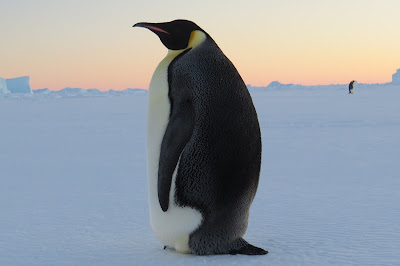
On our first day we spent about two and a half hours with the emperors. They really are a beautiful bird. Their plumage close up is so detailed and intricate, and their colours just blend so well. They look so graceful, but also awkward as they march the many miles across the ice toward the rookery. How they are able to find their way back there year after year is probably something we will never understand.

I sat for a while on the first day just soaking it all in. The scale and beauty of the surrounding bergs, with the light from the low sun was spectacular, and the penguins with their gentle presence just capped it off. At one stage I stood looking around at the scene and I had to sit down. I refer to it as sensory overload, one of the others
Auster Rookery. The sight that greeted us on arrival.
saw me and called it an "Antarctic moment". It happens down here frequently. None of the emperors came overly close to me on the first day, other than one that passed a meter away from me on its way to the rookery. It was as if I wasn't even there, but I was still thrilled never the less. Long before it seemed like what was actually two and a half hours was up, we headed back to the Hagg and began our drunken trail back to the hut for the night arriving at the hut at about 3.30pm, just as a full moon was rising between the bergs. Yet another spectacle. After unloading our gear, Trev cracked a bottle of port, Kate made a up a cheese platter, and the four of us sat down and began a very pleasant evening which capped off a perfect day.
Full moon at Macey.

The next day, we completed our 10am radio sched after a quick clean up, loaded the Hagg and drove back to the rookery. The sight of the line of penguins on the second day was no less spectacular than on our first arrival. This time however they seemed a lot more interested in spending time with us. Kate had one keep her company at about a meter and a half away for over half an hour, while I had several come within three or four meters and just hang out. The highlight was when Kate stood up and wandered off, "her" penguin just stood and looked around as if to say "hmmm, what now?". That was until it spotted me about seventy meters away and seemed like it thought "oooh, there's another one, but that one's red!! I'll check that one out too!!" Straight away it started walking in my direction. She/he (I prefer to think she...) came up and stood about a meter in front of me and made a few noises, then walked around behind me and stopped for a while to check me out. Then, after a few seconds came back in front and turned her back to me while looking over her shoulder. Then, around the back she went again, and again in front with her back turned. I could only figure that what she was expecting me to do was show her what I looked like from behind. She did this about five or six times over the fifteen minutes we spent together. It was both amusing and
intriguing. Eventually it was time to depart on our four hour journey back to Mawson. I was surprised when I stood up, instead of being alarmed my friend just stood there and looked up at me. I explained that I had to go (I doubt she understood) and started to walk away. After a few paces I looked back to see her following me!! She did this for about ten meters and finally stopped and just looked around, seemingly lost as to what to do next. It made me feel like picking her up and bringing her home.

The journey home was via a different route, closer to the coast, with some interesting bergs on the way. We completed out trip in near darkness arriving with just enough time to unpack and squeeze in a beer while describing our trip to others on station and comparing experiences with the others that had already been.
Lone ranger.

New arrivals.


The sea ice remains open for travel through until mid November, so many more trips will be made to Auster by us all. The rookery is an aspect that is unique to Mawson Station so it is up to us all to make the most of the opportunity. It is a sought after posting, so there is no guarantee we will be given the chance to come here again.
Back turned again....


Late afternoon light on the plateau.
A berg on the journey home.
Berg after sunset.


Sunday, 17 May 2015

What we do for entertainment.

I thought I'd write a brief piece on the things we do here at Mawson to liven up Saturday nights. Not every weekend, but probably at least once a month someone organises a special event. In the past we've had a quiz night, and a Hawaiian luau on another occasion.

Yesterday myself and our Station Leader (JL) organised The Mawson Games. This was to be an evening of indoor bowls, table tennis, quoits, table soccer, darts and pool. JL and I spent the afternoon arranging tables, laying the bowls "turf", and "inventing" the rules. Finally it was time to write the draw. Holy shit!! Who would have thought it was going to be so hard?? We drew up a table on the whiteboard, with a column for each sport, and a line for each round. We tried several times to get it right, to the point that my brain was really starting to hurt. Finally JL announced that he'd go to his room and try and nut it out on paper, simultaneously I would attempt to find a programme on-line to help solve the problem. The computer solution was not easy, and in fact I gave up and went back to pen and paper. Just as I'd sorted it JL appeared at my door with the solution in hand also. Confirmation once again in my life that maths was never my strongest skill..... Mind you, I worked it out in the end.

Coinciding with "The Mawson Games" JL discovered that it was "World Whisky" day. So, prior to the games Linc, our beloved Met Observer (seriously, that's his job, he observes the weather!!) hosted a whisk(e)y tasting, complete with notes on the characteristics of each. These ranged from quality single malts, a blended scotch, one Irish Whiskey, and an "up-market" (I use the term lightly) aged bottle of Wild Turkey bourbon. As you'd guess the Wild Turkey was almost undrinkable after sampling Oban single malt, Bushmills 14 year old, and Balvenie 12 year old.... (after a couple of bad experiences as a youth bourbon has long since not been a regular feature of my drinking habits and I admit, I actually "downed" mine after the first sip, as in DOWN THE SINK). Now the irony of the occasion is that Linc, doesn't drink!! Top effort Linc, we enjoyed it.

Now, to match the whisk(e)y our much treasured chef Kim prepared a five course menu to match with the liquor. First up was smoked trout (it was actually salmon) bruschetta. Second course was Salmon Tataki, third was a Crusted Fillet of Blue Eye Trevalla, accompanied by haggis. Fourth course, the main, was Braised Lamb Shanks, and finally dessert was an exceptionally rich chocolate tart, which was matched with a nip of Glenmorangie. Once again Kim outdid himself and everyone loved it. All of it was excellent, but the bruschetta was superb, as was the dessert I thought (as I waddled away from the table).

After a period of cleaning up the kitchen competitors were summoned upstairs to the bar for the draw of teams of two out of a hat and be informed of the rules. Six teams of two were decided, and the games began in a round-robin of ten minute games, with the highest score naturally being the winner of that round. Two rounds were played and then a drinks break was called, followed by another two rounds, another drinks break and then the final two rounds.
Competition on the soccer table was intense.
From left, Kate, Angry, JL, and Robi Wan.
At the end of play a tally up of the points table was done which revealed we had a tie for first place between Team 5 (Charlie and Little Pete) and Team 2 (Kim and Angus). As the judges, JL and I decided the finals would consist of a five minute round of the game of choice of each team, followed by a five minute game of the judges choice if the score remained even after that. Team 5 strategically chose quoits. Angus is only in his twenties, and had never heard of the game before the evening....

Team 5, Charlie dominating the Quoits pitch.
Little Pete and J.B. looking on.
Team 2 somewhat naively chose darts, ignorant of the fact that Little Pete has recently revealed himself as a bit of an expert in the art of spear chucking. Kim is also no slouch with the arrows, and neither is Charlie. Sadly Angus's skills lie in other sporting fields, and he is not so practised at such primitive forms of competition. The winner at the end of the two rounds was clear, and unfortunately for Team 2 the judges round was not necessary.

Team 5, Charlie and Little Pete. Victory favours the brave.
 
Congratulations to Charlie and Little Pete. You battled hard and showed no fear in the face of some tough opposition. An excellent night was enjoyed by all, and for me it was a reminder of statements I'd heard from previous expeditioners. A lot of the enjoyment of time spent down here comes from the people you share it with.

Wednesday, 22 April 2015

Weekend getaway....

One of the best things about living here in Antarctica are the opportunities we have to get off station when the weather is suitable. As I may have mentioned before, there are several huts scattered around our region that we are able to travel to for overnight stays, as well as several local features that can be visited during a day trip.

Last weekend several of us had planned to travel up on the glacier, as much to explore as to have a change of surroundings. As we are only a small community of fourteen we are somewhat limited in when we can actually be off station. Logistically we have to consider rosters such as the ER team (emergency response), slushy, Saturday duties etc. Along with this we have to consider other programs that may be planned for the same time. My escapes are restricted not only by the fact that I am leader of ERT Two, but also that we must have one plumber on station at all times. The maximum number of personnel off station at one time is limited to seven, just to add complication.

Luckily everything lined up in our favour and Saturday morning saw us scrambling around frantically organising food, our survival packs, alcoholic beverages etc along with fuelling up the Hagg (see the photo's to discover what this is) in order to make our get away at the earliest opportunity. Finally the wind dropped below the required 30 knots at 1pm and we were on our way.


The Hagglunds. Kind of like an Antarctic SUV. On steroids.

Rumdoodle Hut was our destination. This is a great little hut that sleeps six (at a squeeze) and sits below Rumdoodle Peak in the North Masson Ranges. The trip for me was about experiencing glacier travel in a Hagg, along with visiting a part of the ranges I've not been to before. The Hagglunds are quite awesome to drive. They can literally go anywhere, with a turbo diesel power plant that has HEAPS of horsepower. I'd love to bring one home to use as a hunting truck. The only thing stopping me will be the $300,000 price tag, and the fact they are only producing them to be used for military applications now.


What a beast.

The drive up was as much fun as I expected. We arrived at the hut in no time at all and then carried on to a peak known as Fearn Hill, which has a couple of small frozen lakes at its foot. A couple of hours was spent here exploring and taking photo's of all sorts of scenery and unusual features in the ice. It seems like every place you visit in this crazy continent has something different to offer. This location presented evidence of dust storms from who knows how many decades or centuries ago. These form layers in the ice which create sweeping lines as the ice flows along and around obstacles ever so slowly.

Painted Peak.

The next day dawned after a few rums (what else would I drink at Rumdoodle...), and not such a sunny day. The majority decision was to lay around the hut for the day relaxing before beginning our journey home. A great opportunity to unwind and get to know my two fellow travellers a little better.
Anyway, they say a picture is worth a thousand words, so I won't ramble on any longer.


Enjoy the photo's. In case you didn't realise you can click on the photo's and view them in a bigger format.

I.G.

Looking back at the North Massons, Hagg in the distance.
A frozen lake, with the layers of dust evident in the glacier ice.
Evidence of ancient dust storms. So I'm told....
 
WTF??
OBO (old bearded one) drives the Hagg.
Looking out over a frozen sea at the end of the journey home.
Fearn Hill.


Sunday, 12 April 2015

Night time phenomena......

I thought I'd write a brief piece on the phenomena that is aurora australis. Rather than try and give an explanation of exactly what an aurora is and what causes them I've borrowed from Wikipedia.

Read on.....

An aurora[nb 1] is a natural light display in the sky (from the Latin word aurora, "sunrise" or the Roman goddess of dawn), predominantly seen in the high latitude (Arctic and Antarctic) regions. Auroras are caused by charged particles, mainly electrons and protons, entering the atmosphere from above causing ionisation and excitation of atmospheric constituents, and consequent optical emissions. Incident protons can also produce emissions as hydrogen atoms after gaining an electron from the atmosphere.

So, if you didn't already know what an aurora was, you do now. I think that gives a good brief explanation of how they come to be also.

Aurora do not occur all the time here, in fact it is only in the last couple of weeks or so that they've really fired up. Certain atmospheric conditions create them , it's all to do with electromagnetic activity blah blah...... So when they do occur we tend to have a spate of them.

As this is my first time in Antarctica I haven't had the opportunity to see many, and those that I had seen were quite a disappointment, given the descriptions I've had from repeat expeditioners. Lately though, we have had them night after night. On Friday night at about eleven o'clock one of our guys came into the bar and advised us to look outside.

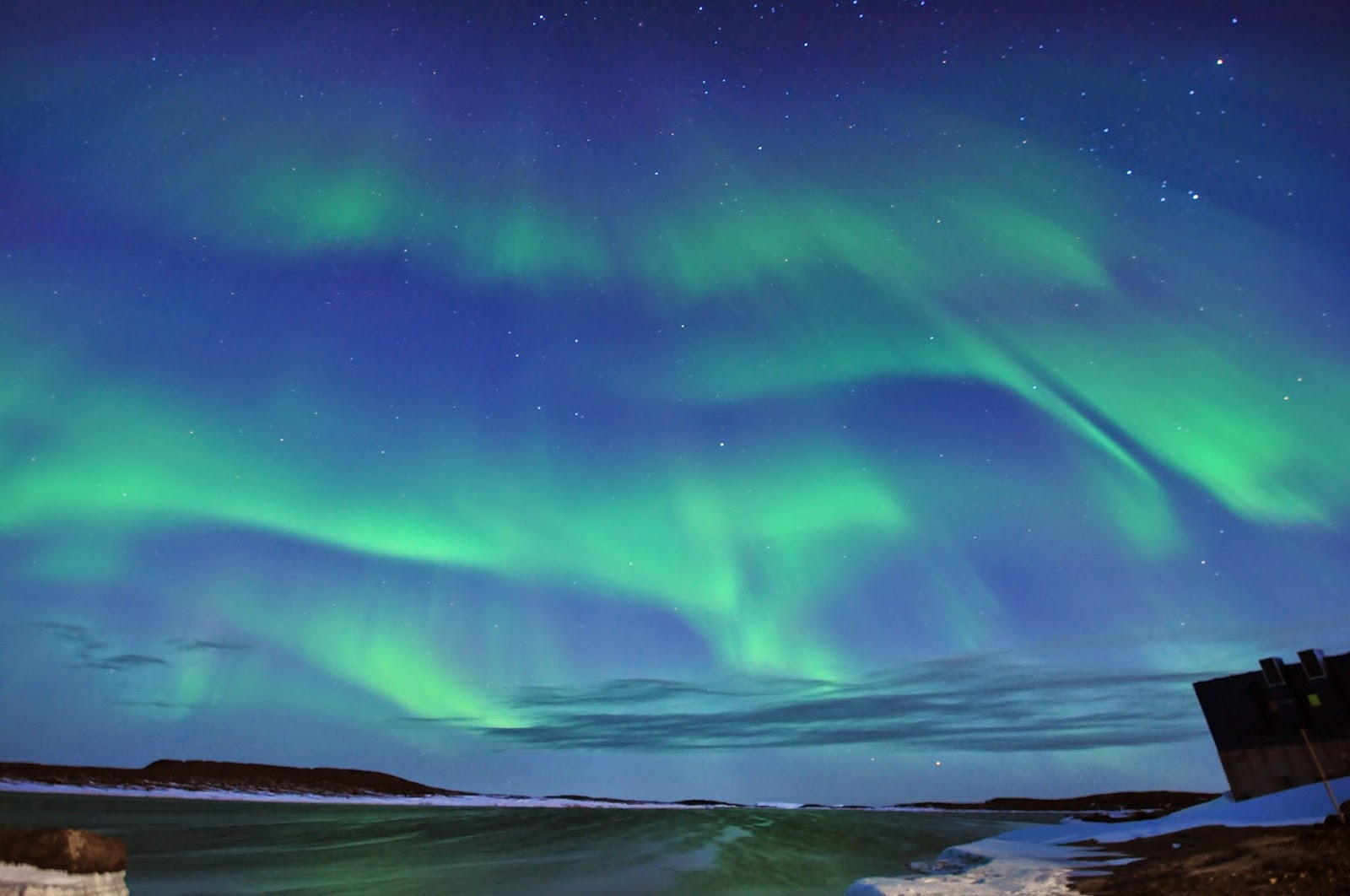
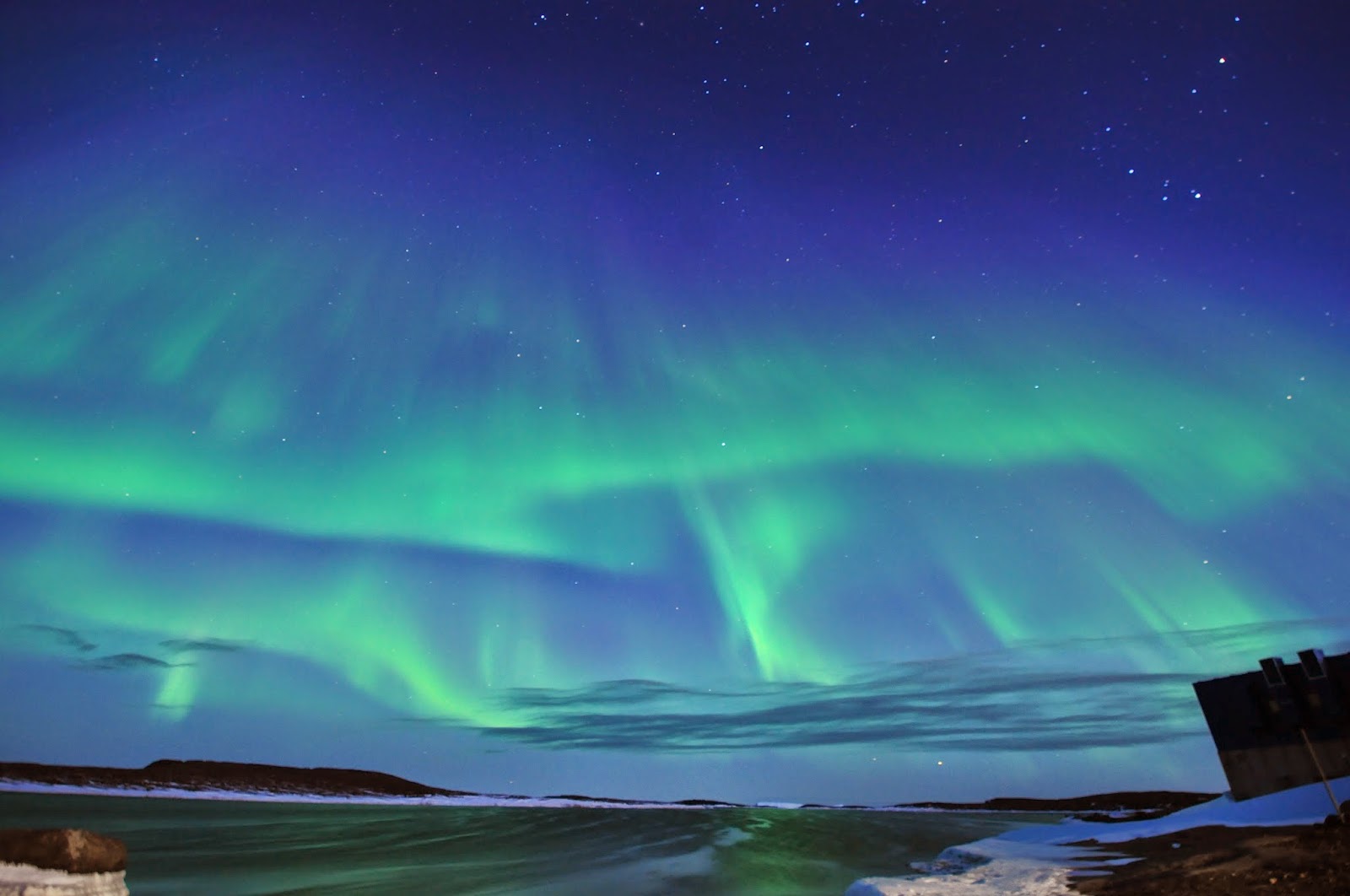
Finally, it was my time to see the show. I spent about forty minutes outside, in -20 degrees, gazing up at the most amazing light show I have ever seen. If I was to simplify it, I'd describe it as beautifully coloured wispy clouds performing a slow dance across the sky. The intensity comes and goes, but when one fades it's always worth waiting to see what's coming next. After the initial aurora that I was viewing faded, out I stood watching the eastern horizon as I could see what looked like beams of light lifting off the glacier. Kind of like headlights coming over a hill. After ten minutes or so it became more intense and colourful, and gradually spread itself across the sky. It was the most incredible sky I have ever seen. Words simply cannot describe how it appeared. It is just another incredible aspect of this amazing part of the world that I will remember forever.

As I said, words simply cannot convey the beauty. I can however admit that it was a very moving experience for me. Don't get me wrong, I'm not talking tears here. It was one of the most peaceful feelings I've ever experienced. As if nothing else in the world existed at the time. Again, it's hard to put into words.

Credit for the photo's must go to Pete Layt, our BSS and chippie. I managed to get a few photo's of my own, but my camera is somewhat limited for scenes like these that require a longer exposure than the maximum of fifteen seconds that mine offers. I'll also add that a long exposure adds intensity of light to the colours, and what the naked eye sees is not exactly as what the camera records. What you do see with the eye still incredibly spectacular. I will add more photo's to this blog at a later date when I get more from Pete, but in the mean time, enjoy.


Monday, 6 April 2015

Major disaster narrowly avoided!!

The week just gone presented some major hurdles for myself and Charlie, the other plumber on station. I'll give you a brief run down on our water supply here before I get too far on with this tale.

Our water is pumped from a cavern in the ice. This cavern is created by circulating water from a "bell" (see the photo's) through pipework which, during its circulation path passes through a heat exchanger. The bell immersed in the cavern is therefore warm, which creates melt. This started many years ago as just some warm pipes on a depression in the ice, which gradually melted into a cavern. If repairs are required on the flow or return line in that system there is always a risk that pipework will freeze up before you are able to complete the repair and reinstate circulation. Worse still, if the circulation is interrupted for too long the cavern will freeze up.


The Melt Bell extracted from the cavern

The former is exactly what happened. The latter is what we narrowly avoided.

On Monday morning we set out to repair a leaking join in the site services pipework (heavily insulated fusion welded polyethylene pipes). This is no easy task as first of all we have to cut away the steel sheathing that encases the expanding foam insulation. This is also encased in heat shrink. Then, once that is done you chip away at the insulation, taking great care not to let any of the foam drift away on the wind, as we go to great lengths to avoid even minimal pollution. Finally, you expose the pipe itself, establish where the leak is, and then replace the offending section. Here is often where the real drama begins, and Monday was no exception. The cause of the leak was a poorly fitted bend, which not only required replacing, but pipework also required realigning. Long story short, the job took us all day and by the time we had the water back on nature had done it's -20 degree business and frozen parts of our pipework.


Team Mawson Plumbing, Charlie and I.

So as you could imagine, pipework encased in insulation does not make it easy to find the frozen part. Our first concern was that we had "dead headed" the pump by trying to circulate water  and stressing the pump, so now we had concerns regarding the integrity of the pump. Also we began to worry that if we couldn't defrost the pipework in a timely fashion the cavern would begin to freeze and thereby freeze the bell and pump. The decision was made to remove the bell the next day, break down as much of the system as we could and begin to thaw things out. In the end we were forced to replace some of the pipework which we'd not been happy with anyway, which will be a good thing in the long run. The bell was transported to the workshop and rebuilt with a new pump and check valve. Finally on Friday after five days of toil melting frozen pipes and keeping them warm, the bell was lowered down into the cavern, pipes were reconnected and tested as we pumped water through in stages, and the water supply was reinstated to near normal function. As we were lowering the bell back into the cavern we could see that an ice crust had formed on the surface of the melt cavern. Another day or two we'd have been in big trouble.

All of this was of course made even harder and more time consuming by the fact that when we were working in the vicinity of the cavern, Charlie and I had to be harnessed up and attached to a belay, attended by two others. This is due to the fact that the cavern is a small hole in the ice that undermines the surface ice, drops seven meters to the water surface, and ten to the bottom. Extracting someone from there would not be easy if you did not already have a rope attached to them. I'd conservatively suggest you'd be dead by the time a rescue plan was implemented. All in all it was a very labour intensive job. There were six of us involved for five days, plus another two for a part of the last day.


The melt cavern, it looks a lot scarier when you are standing on a platform above it winching a water filled bell that weighs over 150kgs out of it.....

In reality the weather saved our bacon. You see normally we have katabatic winds of around 30 knots to deal with every morning until around midday. Katabatic is the term used to describe to winds created by cold air flowing down off a mountain/hill/glacier which continue until the air space they are flowing into heats up and creates pressure of its own which forces the wind to stop, or reverse. Not only do we normally contend with winds, our weather is generally not stable. In fact it is more likely to be bad than good. Some how the weather patterns managed to provide us with five spectacular calm days, where the wind died by 9am each day, and in fact on the Wednesday and Thursday provided cloud cover which created two unseasonal -10 degree days.

Our potable water reserves total approximately 100,000 litres. On average the station consumes 2,000 litres per day. Enough for around seventy five to one hundred days if rationing was forced upon us. We also have another 300,000 litres in reserve for firefighting purposes (seems like overkill to me!!) so had we not been able to reinstate the supply we would have scraped through, but getting it going next summer when things have warmed up would have been a lengthy drawn out process as by then every part of the system would have been frozen solid.

So, all in all we achieved a good result after some creative thinking and problem solving. I guess that is one of the reasons the selection process for these positions are so thorough, enabling them to identify people who can overcome situations such as these when they arise. I have never considered myself as someone who was good at improvising to provide solutions and had concerns that I was going to be out of my depth down here.

Maybe they know me better than I know myself.


New Bell winched into place, mission accomplished..... Nearly.
Team Belay, J.B. and Robbie.

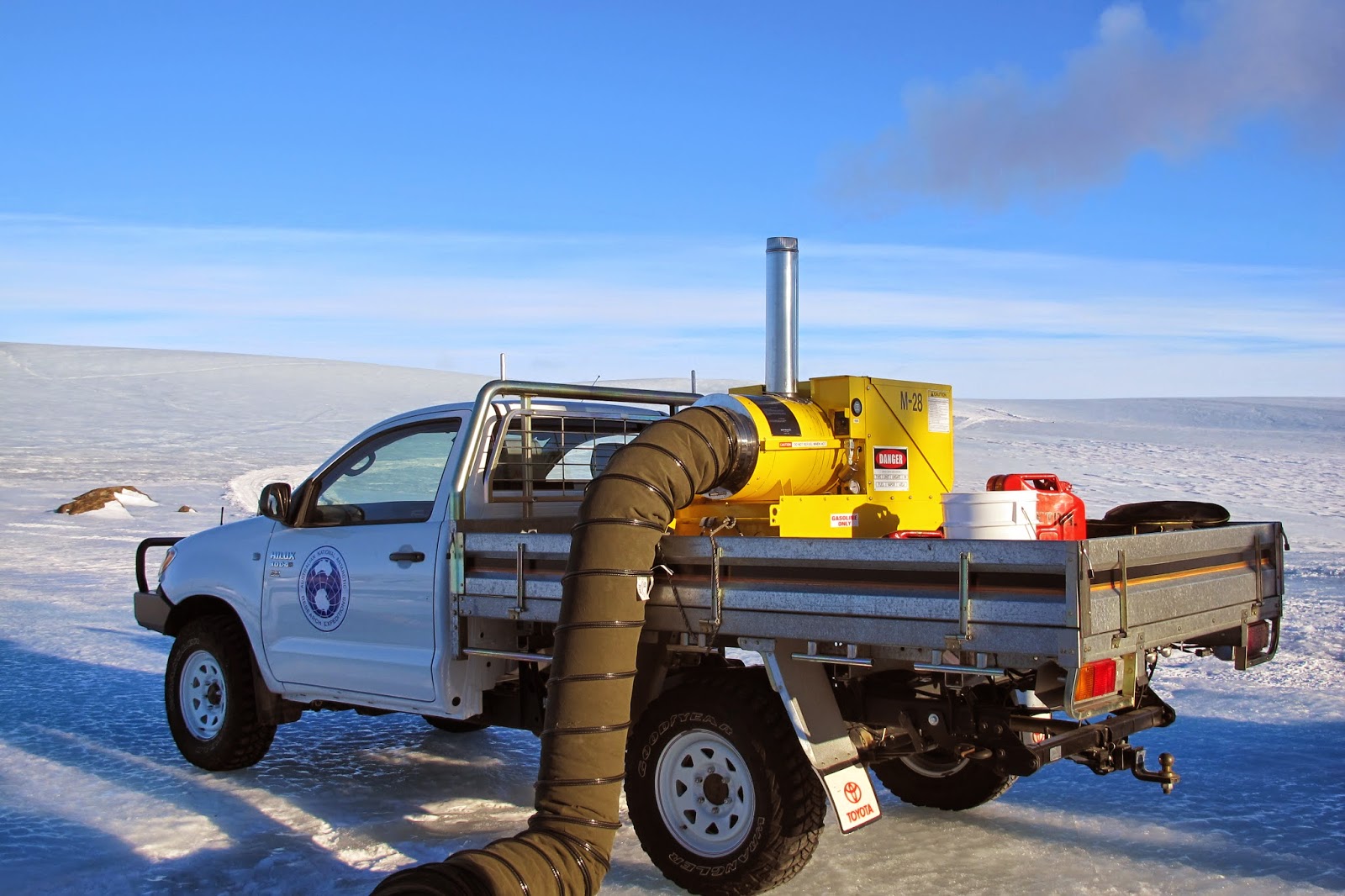
Herman Nelson, one of the big diesel fired heaters we used to defrost things.